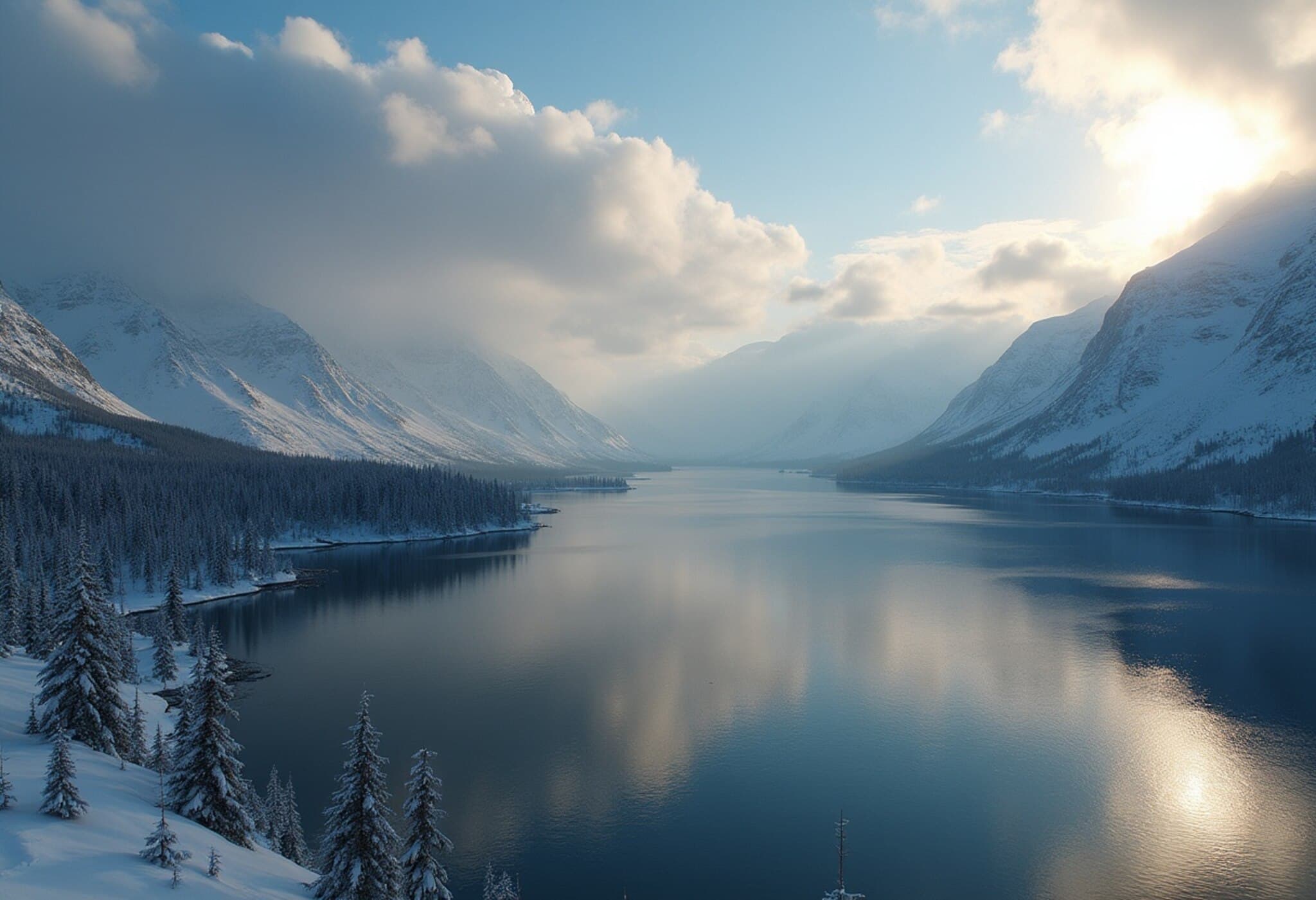

Trump’s Ambition to Acquire Greenland: A Strategic but Contentious Pursuit
President Donald Trump revived an old and controversial idea by expressing his strong desire for the United States to acquire Greenland, Denmark’s semiautonomous Arctic territory. Citing national security concerns and the island’s critical geopolitical importance, Trump insisted during an interview from Air Force One that Greenland is "vital" to American interests. However, this push has sparked fierce opposition from Danish and Greenlandic leaders, exposing deep diplomatic tensions and raising complex legal questions about sovereignty and self-determination in the Arctic.
Greenland’s Geopolitical Significance
Strategically located primarily within the Arctic Circle, Greenland is not just a remote island but a linchpin in emerging global power dynamics shaped by climate change and resource competition. The island hosts a U.S. missile-defense installation and sits astride critical maritime corridors that link the Atlantic Ocean with the increasingly navigable Arctic Sea routes, opening up new avenues for shipping and military navigation amid melting ice.
Beyond military considerations, Greenland’s vast reserves of rare earth minerals—essential components for modern technologies like electric vehicles, smartphones, and defense systems—add to its allure. While China currently dominates the global supply chain for these vital materials, American interest in Greenland could mark a strategic effort to diversify access to these critical resources. Additionally, though potentially rich in untapped oil and gas, Greenland’s local government has resisted drilling, emphasizing environmental protection and sustainability.
The Complex Political Landscape of Greenland
Greenland is a self-governing territory within the Kingdom of Denmark, which colonized the island over 300 years ago. Although Denmark retains control over foreign policy, defense, and monetary affairs, Greenland has gained increasing autonomy since 2009, managing most of its internal affairs such as education, policing, and natural resource decisions. Economically, Greenland remains heavily dependent on Danish subsidies, funding vital infrastructure, social services, and energy subsidies.
Crucially, the people of Greenland have advocated to maintain their political and cultural integrity. Surveys consistently reveal overwhelming opposition among Greenlanders to any proposal that would see their island absorbed by the United States. This sentiment reflects a strong desire to preserve their unique identity, traditions, and self-determination—in stark contrast to Trump’s vision of American acquisition.
Danish and Greenlandic Resistance to U.S. Acquisition
Denmark’s Prime Minister Mette Frederiksen unequivocally rejected Trump’s overture, urging the United States to cease all "threatening" rhetoric and respect Greenland’s sovereignty. Greenland’s Prime Minister, Jens-Frederik Nielsen, called Trump’s attempts to link military operations in Venezuela with Greenland’s status "utterly unacceptable" and cautioned against undermining bilateral relations rooted in respect and diplomacy.
From a legal standpoint, the prospect of the U.S. annexing Greenland is fraught with complications. Such a move would violate fundamental principles of international law regarding sovereignty and territorial integrity, not to mention the foundational agreements underpinning the NATO alliance, where both Denmark and the U.S. are key members. Military intervention is not only diplomatically explosive but would also irreparably damage transatlantic ties and global stability.
The U.S. Strategic Playbook: Economic Incentives vs. Hard Power
During his administration, Trump reportedly considered using economic leverage, including suspending subsidies to Greenland through Denmark, to pressure political changes. In a direct appeal to Greenlanders, Trump promised billions in investments and job creation to "make you rich," seeking to sway local opinion towards joining the U.S.
Yet, Greenland’s government proactively tightened regulations to protect political autonomy and environmentally sensitive industries, including a 2021 ban on uranium mining and other extractive activities perceived as harmful. These measures further complicate any U.S. ambitions by reinforcing Greenland’s self-governance and regulatory independence.
Comparing Military Capabilities: Denmark vs. The United States
The United States fields the world’s largest military, boasting over 1.3 million active service members and advanced capabilities worldwide. Denmark, by contrast, maintains a modest defense force of fewer than 20,000 personnel with limited independent capabilities, relying heavily on NATO and allied support for broader security.
Experts agree that Greenland cannot realistically defend itself against U.S. military power, with scholars emphasizing the asymmetry of force and the diplomatic fallout any military move would provoke. The Danish Institute for International Studies has described a potential U.S. attempt at annexation as "impossible" without severe consequences.
Editor’s Note: What Does Greenland’s Future Look Like Amid Global Shifts?
President Trump’s renewed interest in Greenland illuminates the growing global competition for Arctic influence, resource security, and strategic military positioning. Yet this ambition clashes head-on with the island’s strong local will and international law. Greenland stands at a crossroads, balancing external pressures and internal sovereignty claims amid a rapidly changing geopolitical climate shaped by climate change and technological innovation.
As Arctic geopolitics heat up, critical questions remain: How will the U.S. and its allies honor the self-determination of Arctic peoples? What mechanisms can be strengthened to ensure cooperation over competition in the fragile polar environment? And what role should environmental stewardship play in shaping the future of resource-rich territories like Greenland?
Understanding these nuanced dynamics is essential for policymakers, scholars, and citizens alike as the Arctic emerges as a new frontier for global influence and the stakes for indigenous and international communities continue to rise.